

14 Best MVP Examples and What Each One Tested
A minimum viable product (MVP) is the smallest thing you can put in front of real people to find out whether the riskiest assumption behind your idea holds. The best-known minimum viable product examples are tests like that: Dropbox's demo video, Zappos's photos of one store's shoes, Airbnb's airbeds for a sold-out conference and DoorDash's page of PDF menus.
Every story below is checked against what the founders said and wrote, archived copies of their first pages, and company filings, so some details differ from the usual retellings. Dropbox's demo video, for one, showed software that already worked. Each entry covers what the MVP tested, what counted as a yes, and what the founders already had going for them, from a Twitter following to a sold-out conference in their own city. That last part matters most if you're starting without an audience, so each entry ends with what you can copy without it.
No-code waitlist builder with landing pages, referrals and email automation. Launch your product to an audience that's already waiting.
Get startedThe 14 best MVP examples at a glance
| # | Example | MVP type | What it tested | What they had going for them |
|---|---|---|---|---|
| 1 | Dropbox (2007–08) | Demo video | Do people want file syncing enough to join a beta? | A working prototype, Hacker News |
| 2 | Buffer (2010) | Landing page with a pricing step | Do people want a tweet scheduler, and will some pay? | A Twitter following |
| 3 | Zynga (2009) | Fake door | Is a game idea worth building? | Its own players |
| 4 | Food on the Table | Concierge | Will families pay weekly for meal plans? | Interviewees and referrals for the next customers |
| 5 | Zappos (1999) | Wizard of Oz | Will people buy shoes online without trying them on? | A store willing to play along |
| 6 | DoorDash (2013) | Concierge | Will people order delivery from restaurants that don't deliver? | A Stanford campus |
| 7 | Zapier (2011–12) | Hand-run paid beta | Will people who ask for integrations pay for them? | Cofounders who could code |
| 8 | Airbnb (2007) | Concierge, for one event | Will people pay to sleep in a stranger's home? | A sold-out conference in their field |
| 9 | Groupon (2008) | Piecemeal | Will locals buy a deal that needs enough buyers to go ahead? | A funded team and a mailing list |
| 10 | Product Hunt (2013) | Piecemeal | Will product people read and add to a daily list? | A blog, an email list, a network |
| 11 | Nomad List (2014) | Piecemeal | Do remote workers want cities ranked by cost and quality of living? | Earlier launches with press coverage |
| 12 | Pebble (2012) | Pre-order | Will people prepay for a smartwatch? | A watch already shipped, a prototype |
| 13 | Tesla Model 3 (2016) | Refundable deposit | Is there mass-market demand before production? | A brand, stores, existing owners |
| 14 | Palm Pilot (c. 1995) | Non-working model | Can a pocket device beat paper on speed? | Years of building handhelds |
The years are when each test ran.
Show it before it's ready: video, landing page and fake door MVPs
These test interest: people watch or read, then leave an email or click. They need a steady flow of the right visitors, and since an email costs nothing to give, it's the weakest yes. Why waitlist signups don't convert explains the gap between a signup and a sale.
1. Dropbox: a demo video with a beta signup form
MVP type: demo video and signup page · What counted as a yes: beta signups
In April 2007, Drew Houston posted a three-minute screencast of Dropbox to Hacker News, on a page with an email form for the beta. In the comments, he said he'd built the prototype alone, in Python, with encrypted files stored on Amazon S3. So the video showed working software, and what it tested was whether people wanted it.
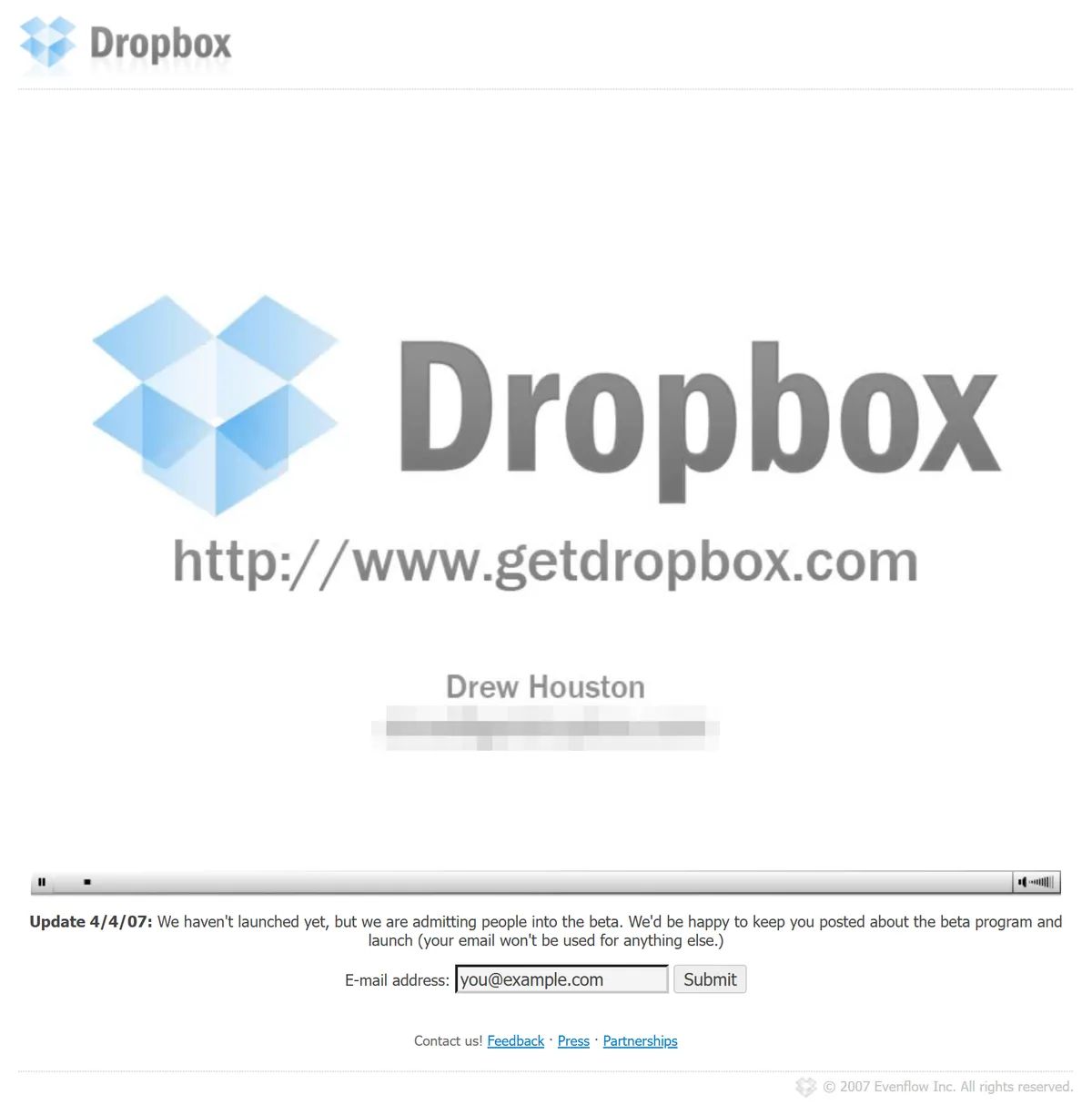
Dropbox's beta page on April 7, 2007: the screencast, a note that the beta was already admitting people, and an email field. Wayback Machine capture
The big jump came in March 2008. A second video, full of in-jokes for Digg's readers, got more than 10,000 Diggs within a day, and Houston said the beta waiting list went from 5,000 to 75,000 people "literally overnight."
What they had going for them: Houston could build the product himself, and he posted while applying to Y Combinator, which runs Hacker News.
What you can copy: a short video of your product doing its one job, with a signup form under it, made for one community where your future users already spend time, the way the second video was made for Digg.
2. Buffer: a landing page that asked visitors to pick a plan
MVP type: landing page with a fake pricing step · What counted as a yes: emails, then clicks on paid plans
Joel Gascoigne's first test of Buffer was two pages. The first described a way to tweet more consistently, with a "Plans and Pricing" button. The second said "Hello! You caught us before we're ready" and asked for an email. He tweeted the link, and a few people left their email and wrote to him. Then he added a plans page in the middle (free, $5 a month or $20 a month), and a small number of visitors clicked a paid one.
Those pages never took money. Gascoigne built the product over seven weeks of evenings and weekends, launched it on November 30, 2010, and had his first paying customer within four days.
What they had going for them: a Twitter following, a previous startup and the skills to build the product himself.
What you can copy: show your price before the signup form, so every signup comes from someone who has seen it.
3. Zynga: five-word game pitches that led to a 404 page
MVP type: fake door · What counted as a yes: clicks
In a 2009 talk at Stanford, Zynga founder Mark Pincus explained how the company tested a game idea before building it. The idea was boiled down to about five words, like "Hey, you ever fantasize about running your own hospital?", and run as a link for five minutes. A click led to a survey, an email form or a page that said "404 not found." Ideas that drew clicks got a rough one-week build, shown to a slice of players.
What they had going for them: players. Pincus put Zynga's play at over 500 million hours a month, so a link that ran for five minutes reached a lot of people.
What you can copy: the habit of pitching before you build, using bought traffic. In the same talk, Pincus said you "could spend 50 bucks a day" on ads "and know most of what we know."
Do it by hand: concierge and Wizard of Oz MVPs
Here a person does the work the product would do later. In a concierge MVP, the customer knows a person is doing it. In a Wizard of Oz MVP, the customer sees what looks like a finished product, with someone working behind it. Both need only a few customers, who pay or order for real, but they can't tell you whether the business works once you stop doing everything yourself.
4. Food on the Table: one customer and a weekly check
MVP type: concierge · What counted as a yes: $9.95 a week
Food on the Table, a startup in Austin, Texas, set out to sell weekly meal plans and grocery lists built from the foods a family likes and what's on sale at its grocery store. In Eric Ries's account in The Lean Startup, CEO Manuel Rosso and his VP of product went to supermarkets and moms' groups in Austin, interviewed people, and ended each interview by offering the service for a weekly fee. Most turned them down. One said yes, and got the concierge version: they planned her meals by hand, Rosso met her every week, and each week they collected a check for $9.95, without having built any software.
What they had going for them: people to ask. Rosso's own slides say they found customers 2 to 20 through people they'd met in early interviews, "mavens" they asked to recommend candidates, and their own networks.
What you can copy: find one person with the problem, do the job for them by hand and charge from the first week. One person paying weekly tells you more than a page of free signups.
5. Zappos: one store's shoes, bought at full price
MVP type: Wizard of Oz · What counted as a yes: paid orders
In 1999, Nick Swinmurn wanted to know whether people would buy shoes online without trying them on. As he told Fortune, he went to a shoe store in Sunnyvale, California, and made an offer: he'd photograph its shoes and put them online, and when someone bought a pair, he'd buy it from the store at full price. The store agreed, and a few orders came in from shoppers who saw only an online shoe store.
It started with that one store, and the money came after: $150,000 from friends, coworkers at Silicon Graphics and his chiropractor.
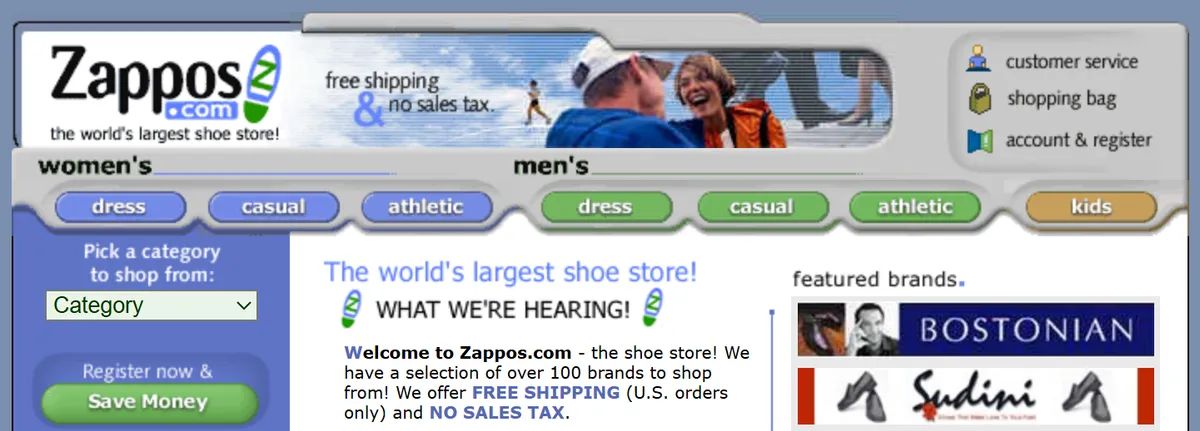
Zappos.com in November 1999, a few months after the test, once Shoesite.com had been renamed. Shoesite.com's earlier captures have no images. Wayback Machine capture
What they had going for them: a store willing to play along, a contract job at Silicon Graphics that paid his bills while he raised money, and a number for investors: he told Tony Hsieh that 5% of US shoe sales already went through mail-order catalogs, where nobody tries anything on.
What you can copy: sell a product before you stock it, and buy it only when an order comes in. Keep the test small enough that paying retail doesn't hurt.
6. DoorDash: PDF menus and the founders' own phone number
MVP type: concierge · What counted as a yes: phone orders
In January 2013, four Stanford students wanted to test whether people in Palo Alto would order delivery from restaurants that didn't deliver. They spent an afternoon on a page called PaloAltoDelivery.com: PDF menus from local restaurants and, at the bottom, their own cell phone number. According to DoorDash's IPO filing, the first order came within a few hours, for pad thai. The founders picked up the food and delivered it themselves, and kept delivering after class, with Square for payments and a Google Doc to track orders.
What they had going for them: a campus. Cofounder Stanley Tang said, "I sent out one email to my dorm," and they had already interviewed dozens of local business owners.
What you can copy: a page with a phone number or an email address is enough to take the first orders. Do the work yourself and write down every step you repeat: those are the first things to build.
7. Zapier: integrations set up by hand for people who asked
MVP type: hand-run paid beta · What counted as a yes: payments
Zapier's founders went looking for people who already wanted the product. Wade Foster found forum threads where people asked for integrations between apps like Evernote, Salesforce and Dropbox, and replied that he was working on one, with a link. Each reply brought 10 to 20 visitors, and about half of them, he said, told him they really wanted it. The first few beta users paid $100, and the price then came down to around $5 or $10. Foster set up each customer's integration himself on a Skype call, using a prototype customers couldn't yet set up on their own.
By their second application to Y Combinator, Foster said, about 1,000 people had paid for beta access and another 10,000 were waiting on a launch list.
What they had going for them: cofounders who could build the integrations, and day jobs that paid the bills.
What you can copy: find the threads where people ask for what you want to build, answer them, and link to a page that takes an email or a payment. Check each forum's rules on links before you post one.
8. Airbnb: airbeds for one sold-out conference
MVP type: concierge, for one event · What counted as a yes: paying guests
In October 2007, as Joe Gebbia told a TED audience, a design conference came to San Francisco and the hotels sold out. Gebbia and Brian Chesky, short on rent, built a site overnight to offer the airbeds in their own apartment. When other designers in the city emailed to ask whether they could list their spare space too, the founders added them, alongside a guide to the conference. Three guests stayed on the founders' airbeds and got breakfast, and the founders made close to $1,000 that week.
An archived copy of the site from October 13 shows four listings, free to post, with bookings arranged by email. The founders emailed design blogs about it, and their first guest found it on one.
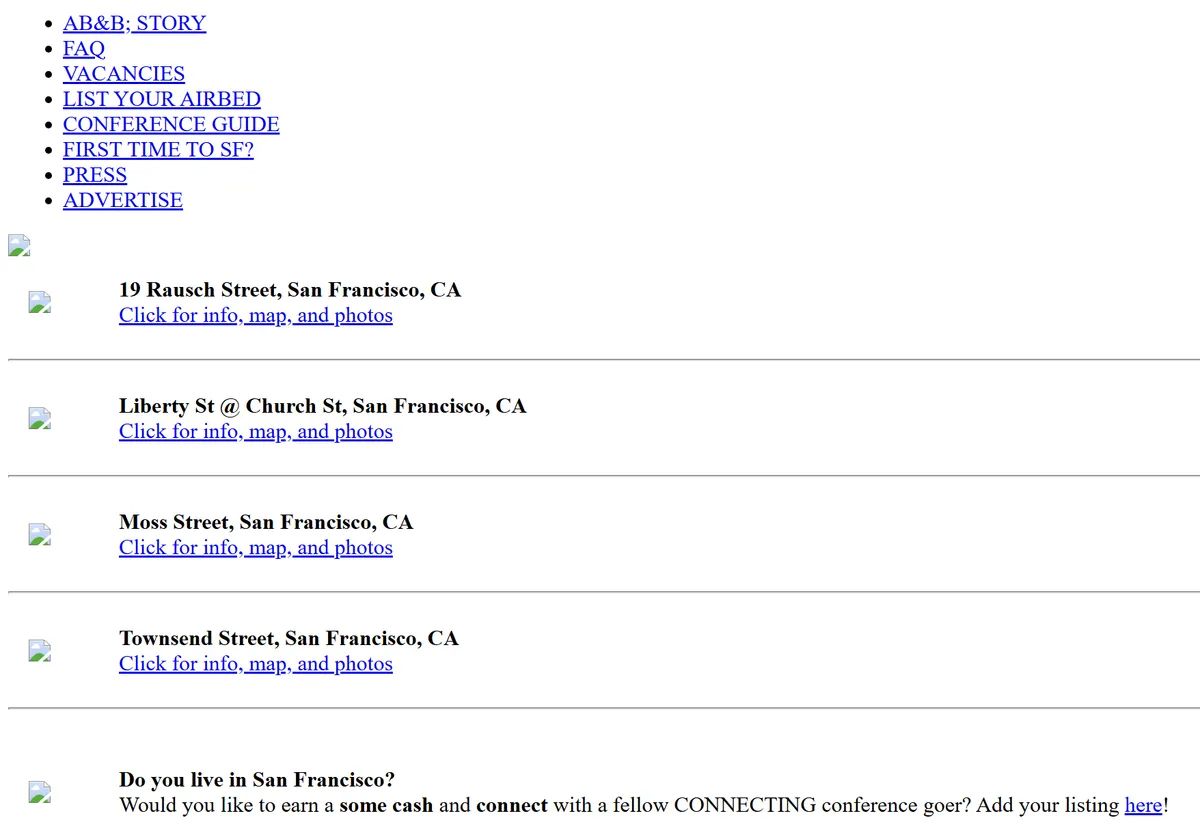
Airbed & Breakfast's listings page on October 13, 2007. The archive didn't keep the site's stylesheet or photos, so it shows as plain text. Wayback Machine capture
What they had going for them: a sold-out conference in their own profession, in their own city, and design blogs willing to write about them.
What you can copy: run the first version for one event or deadline, when a crowd has the problem at the same moment and you only need to reach them.
Stitch it together from tools that exist: piecemeal MVPs
These deliver the real service on software someone else built. People use it the way they'd use the finished product, so you see whether they come back, but not what the real thing will cost to build or whether the workaround holds up as you grow.
9. Groupon: a WordPress blog, FileMaker and Apple Mail
MVP type: piecemeal · What counted as a yes: about two dozen buyers for the first deal
Groupon started inside The Point, a funded startup built around group campaigns. As Andrew Mason told Mixergy, the first version was a WordPress blog with a Groupon theme. Coupons were PDFs made in FileMaker and emailed with Apple Mail, even after a later sushi deal sold 500 in a day. The first deal ran on October 21, 2008: two pizzas for the price of one at Motel Bar, downstairs from the office, for $13. It only went ahead if enough people bought, and about two dozen did.
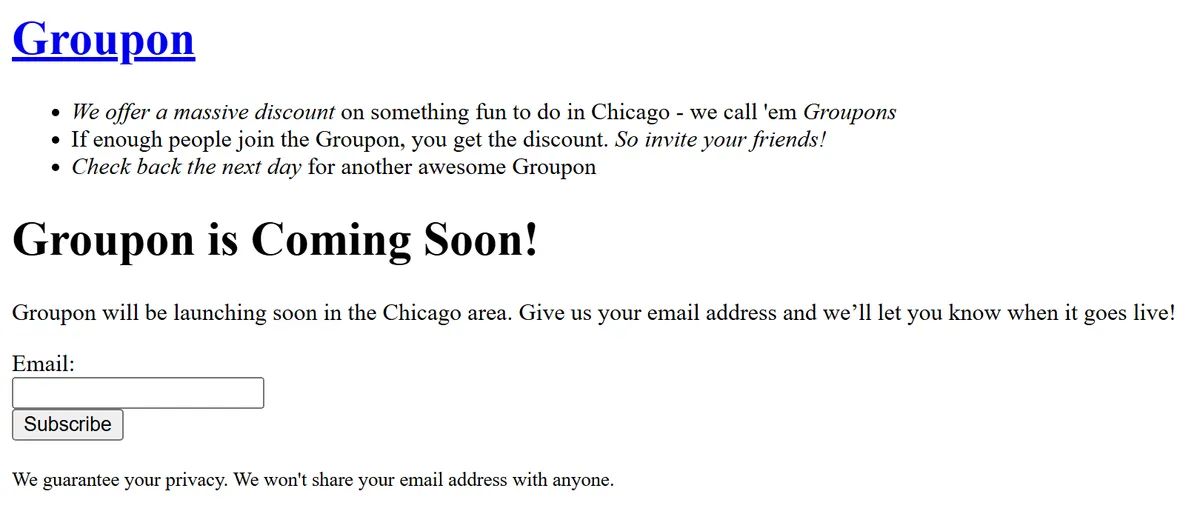
Groupon's pre-launch page on October 4, 2008, 17 days before the first deal. It asked for an email and set out the rule: "If enough people join the Groupon, you get the discount." The page's styling wasn't archived. Wayback Machine capture
What they had going for them: The Point's team of about seven, $1 million in angel funding and $4.7 million more raised in January 2008, a mailing list of 500 people, and a first deal aimed at their own building.
What you can copy: run the first version on tools you already know. A blog, a spreadsheet and an email client can serve your first few hundred customers until something breaks.
10. Product Hunt: an email list set up in 20 minutes
MVP type: piecemeal · What counted as a yes: subscribers and contributors
In November 2013, Ryan Hoover started Product Hunt as a daily email. Product people he invited shared new products through Linkydink, a link-sharing tool from Makeshift, and subscribers got each day's links by email. Hoover has said it took 20 minutes to set up. He invited a couple dozen people he knew and soon had a couple hundred subscribers.
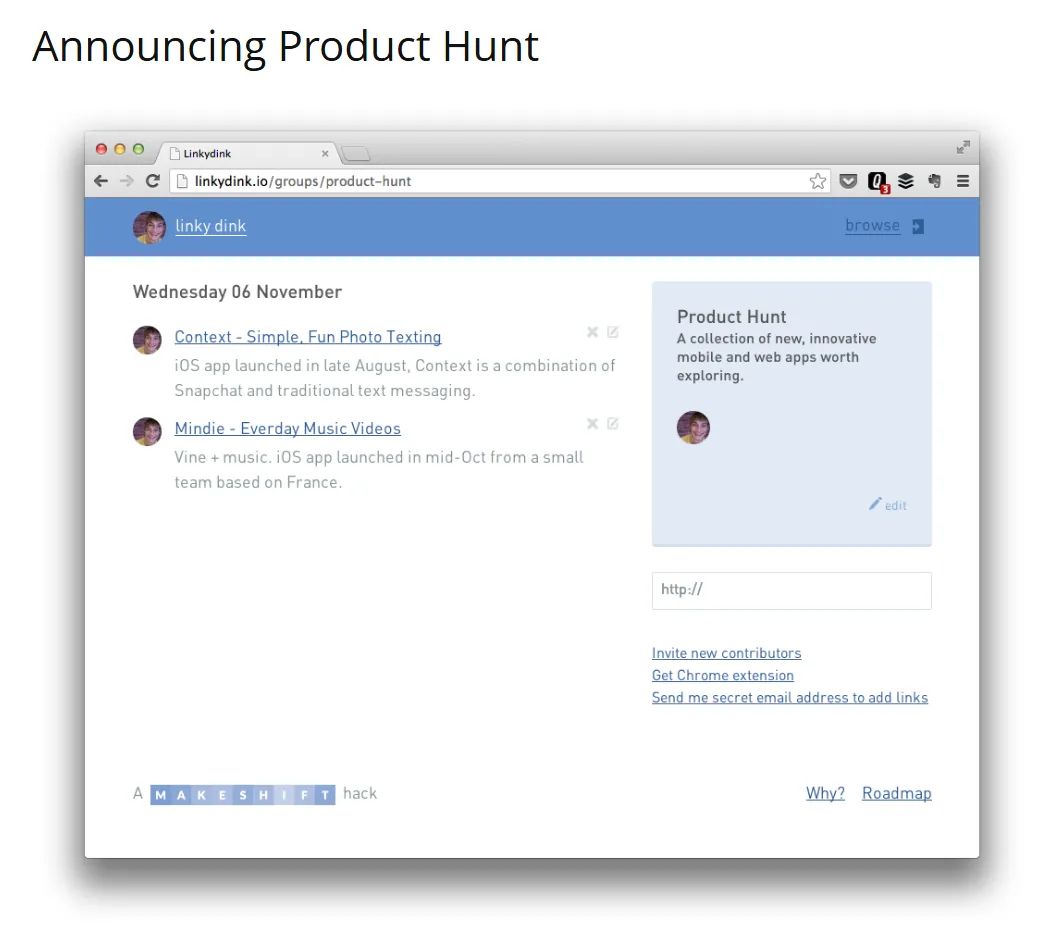
Hoover's November 2013 post announcing Product Hunt, with a screenshot of the first version: a group page on Linkydink. Wayback Machine capture
What they had going for them: Hoover was a director of product at PlayHaven, a mobile games platform in San Francisco, with a blog, his own email list and an active Twitter account. "If I hadn't been blogging and active on Twitter," he said, "I think it would have taken way longer for Product Hunt to become what it is right now."
What you can copy: if your product is a list, a digest or a set of recommendations, send it by email first. You'll see whether people open it and add to it before you write any code.
11. Nomad List: a public spreadsheet
MVP type: piecemeal · What counted as a yes: people editing and sharing the sheet
In June 2014, Pieter Levels wanted to know whether remote workers cared about a ranked list of cities. Instead of building a site, he made a public Google spreadsheet of cities and their cost and quality of living, and tweeted an invitation to edit it. People filled it in and added columns, such as safety, coffee shop density and LGBTQ-friendliness. Levels wrote that the reaction on Twitter answered his question. He built the site, which went live at the end of July and reached number one on Product Hunt and Hacker News.
What they had going for them: Nomad List was the fourth project in Levels's "12 startups in 12 months" challenge. His launches earlier that year had drawn press coverage, and he had a Twitter following.
What you can copy: if the value is the data, publish it as a spreadsheet and ask people to add to it. The columns they add are your first feature list.
Take money before it exists: pre-order MVPs
A pre-order asks people to pay before there's anything to use. That's a stronger yes than an email, and it's a promise: you owe people the product or their money back.
12. Pebble: a Kickstarter campaign with a $100,000 goal
MVP type: pre-order (crowdfunding) · What counted as a yes: pledges
In April 2012, Pebble put an e-paper watch for iPhone and Android on Kickstarter with a $100,000 goal. Founder Eric Migicovsky said later that money from friends, family and a couple of angel investors hadn't been enough to make the watch, so they turned to Kickstarter. A watch cost $115, or $99 for the first 200 backers. When the campaign closed in May, 68,929 backers had pledged $10,266,845.
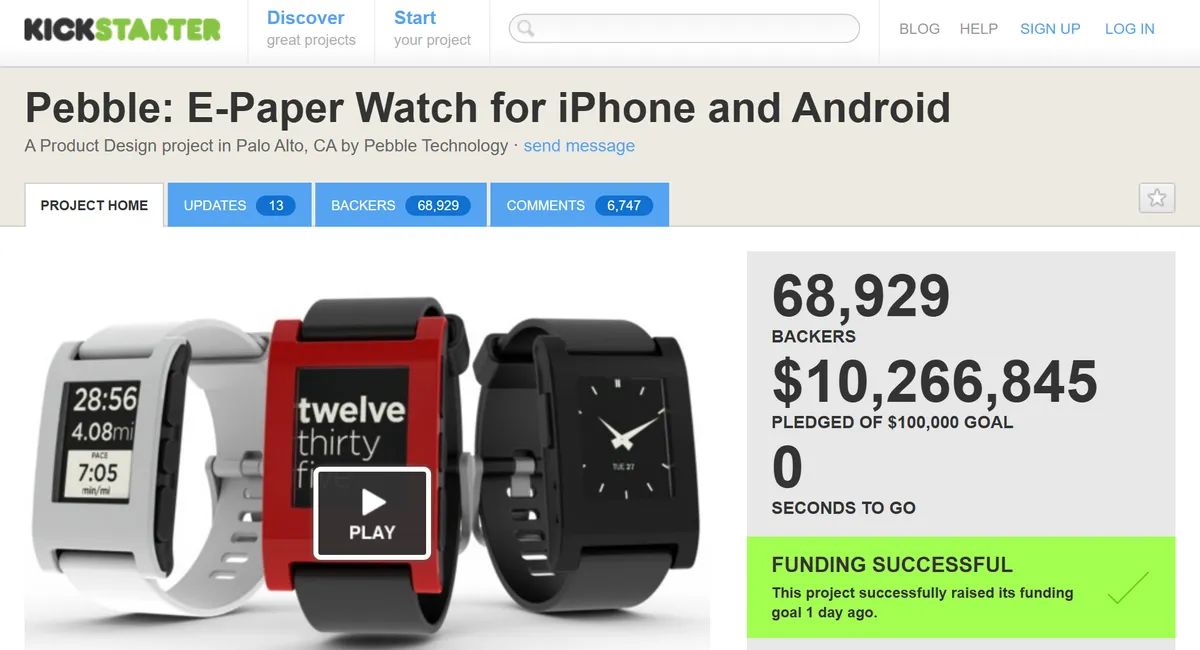
Pebble's Kickstarter page on May 20, 2012, after the campaign closed on May 18. Wayback Machine capture
What they had going for them: it was the team's second smartwatch. They'd spent three years designing them and had already shipped the inPulse for BlackBerry. They also had Y Combinator, angel money and a working prototype.
What you can copy: a pre-order with a price and a delivery date, taken on Kickstarter or with a payment link on your own page. Show a working prototype and promise a date you can meet. The Kickstarter pre-launch page guide is about building interest before a campaign opens.
13. Tesla Model 3: refundable deposits, more than a year early
MVP type: refundable deposit · What counted as a yes: reservations
On March 31, 2016, Tesla opened reservations for the Model 3, which it planned to start producing in late 2017. A reservation cost about $1,000 and was fully refundable. A week later, Tesla reported more than 325,000 reservations and said it hadn't advertised. Its May 2016 filing counted about 373,000, net of about 8,000 cancellations and about 4,200 reservations Tesla canceled because they could have been duplicates from speculators.
Tesla's post that week put the 325,000-plus reservations at about $14 billion in "implied future sales," a figure often repeated as pre-orders.
What they had going for them: a well-known brand, its own stores, more than 122,000 cars already delivered and a live unveiling. Not advertising means less with all that behind you.
What you can copy: the refundable deposit. It asks for more than an email and less than a full payment. Count cancellations as part of the result, the way Tesla's filing did.
Try the design on yourself: a non-working model
A non-working model is a stand-in you use yourself as if it were the real thing. It shows whether the design works before you build anything, though not whether anyone else wants it.
14. Palm Pilot: a block of wood and a chopstick
MVP type: non-working model · What counted as a yes: fewer steps than paper
Before Palm built the Pilot, Jeff Hawkins made a wooden model of it. The Computer History Museum, which holds it, says he used a chopstick as a stylus, took pretend notes in meetings and counted the steps common tasks took. Later, the team glued printed screenshots onto it to check whether the text was big enough to read. Palm's previous handheld, the Zoomer, had failed, mainly because it was too slow, Hawkins said. His targets for the Pilot included fitting in a shirt pocket, costing under $300 and being "really fast." It went on sale at $299.
It's often described as a balsa block he carried in his pocket for months. Hawkins said it was "a hardwood model," and that the shirt pocket was a size target, "not that I would carry it that way."
What they had going for them: Hawkins had designed an earlier pen computer, the GRiDPad, and Palm had venture backers, though it ended up selling itself to U.S. Robotics to pay for the Pilot.
What you can copy: before you build, use a fake version yourself for a week: a paper mockup, a clickable design or a block of wood. Count where it takes more steps than what people use today.
What is a fake door test? Examples and how to run one
A fake door test shows people an offer, button or link for something that doesn't exist yet and counts how many try to use it. The people who click see a note that it isn't ready, ideally with a way to hear when it is. It measures interest before you build anything.
Two of the examples above are fake doors:
- Buffer's pricing page. Visitors who picked a paid plan reached "Hello! You caught us before we're ready" and an email field.
- Zynga's five-word links. A click led to a survey, an email form or a 404 page.
Inside an existing product, the door is often a button or menu item for a feature you haven't built. When the door is a whole landing page, some teams call it a smoke test.
Say plainly on the page behind the door that the thing isn't built yet, and give people something for their click, like a place on the list. Then ask the people who signed up what they expected to find.
Which type of MVP should you build?
Pick the type that tests your riskiest assumption with the people you can reach. If nobody knows you yet, start with a test that needs a handful of people, like a hand-run service you charge for, before one that needs a steady flow of visitors.
| If you need to learn | Try | What it needs |
|---|---|---|
| Whether anyone wants it | Demo video, landing page or fake door | A steady flow of the right visitors |
| Whether people will pay | Concierge or Wizard of Oz, charged from the start | A handful of people with the problem |
| Whether enough people will pay to justify building it | Pre-orders or refundable deposits | An audience, or a prototype people can see |
| Whether people keep using it | Piecemeal, on existing tools | A few dozen users |
| Whether the design works | A non-working model | Only you |
Most of the founders above had an audience, a network or funding before they ran the test. If you're starting with none, copy what Food on the Table and Zapier did: they found customers one at a time, in person or in forums, and charged them from the start. Run a landing page MVP once you know where its visitors will come from. How to get waitlist signups when you have no audience is about finding them.
Building is also cheaper than when these tests ran: with AI coding tools, a working first version can take days. Finding people to try it is the slow part now.
How to run a landing page MVP
- Write down the assumption, and the result that would make you stop. Pick the number before you see any results, so a weak result can't talk you round. How to validate a product has benchmarks to start from.
- Decide where the visitors will come from, before you build the page. That could be forums where people ask for what you're building (Zapier), a community you can make something for (Dropbox's Digg video), one email to a group you belong to (DoorDash's dorm) or a small ad budget (Pincus's $50 a day). Places to promote a pre-launch product lists more.
- Build one page with one offer. Give it a headline that names the problem, a line on what the product does, the price if you're testing one, and an email field. Waitlister's free plan covers this step with a hosted signup page and a list of up to 100 subscribers, which is enough for a first test. Setup steps are in how to create a waitlist.
- Ask one question at signup. For example, "What do you use for this today?", or a choice between two prices. Surveys are on every Waitlister plan, including Free, and the answers come in with each signup.
- Write to the people who sign up. Email the first ones yourself and offer a call, or the hand-run or paid version. On every plan, Waitlister can email you about each new subscriber and export the list as a CSV. Welcome emails for new subscribers and broadcasts to the whole list need the Launch plan or higher, and the waitlist email templates have wording you can adapt.
- Compare the result with the number you wrote down. If it falls short, change one thing, such as the headline, the audience or the offer, and run it again. Or stop.
Frequently asked questions
What are the different types of MVP?
The common types are demo video and landing page MVPs, fake door tests, concierge MVPs, Wizard of Oz MVPs, piecemeal MVPs built from existing tools, pre-orders, and non-working models. Each tests a different assumption. Interest tests are the quickest to run, while pre-orders and hand-run services show whether people will pay.
What is an example of a minimum viable product?
Zappos is one of the best-known. In 1999, Nick Swinmurn photographed shoes at a store in Sunnyvale, California, put the photos online, and bought each pair from the store at full price when someone ordered it. That tested whether people would buy shoes online without trying them on, before he had any stock.
What is the difference between an MVP and a prototype?
A prototype shows whether something can be built and how it should work, and you usually test it with your team or a few users. An MVP tests whether people want it, with real users or customers, often for money. They can overlap. Dropbox's demo video showed a working prototype, and the video with its signup form was the MVP.
What is a Wizard of Oz MVP?
A Wizard of Oz MVP looks like a working product to the customer while people do the work behind it, as with Zappos's first orders. The name comes from 1980s computer usability research, where a hidden person played the part of the software. Doing the work by hand while you test demand is fine, as long as you don't tell investors it's automated. In April 2025, US prosecutors charged the founder of the shopping app Nate with fraud, alleging that purchases investors were told were automated had been completed by contractors.
How do you create an MVP?
Start with the assumption that would sink the idea if it were wrong, such as whether anyone will pay. Pick the cheapest test that would show it, decide in advance what result means stop, and run it with real people, then talk to the ones who say yes. How to validate a product goes through the full process.
What is another term for minimum viable product?
There's no exact synonym, but several terms overlap. A pretotype, Alberto Savoia's word, is a quick fake version used to test an idea before building the real one. A prototype tests how something will work. A minimum marketable product is the smallest version you can sell.
Helpful resources
- How to validate a product before you build it
- How to create a waitlist, step by step
- How to get waitlist signups when you have no audience
- Why waitlist signups don't convert
- Pre-launch marketing strategies, sorted by the audience they need
- Places to promote a pre-launch product
- Kickstarter pre-launch page guide
- Waitlist email templates
- Coming soon page examples